The Soil of Los Haitises National Park: Limestone Terrain, Organic Matter and Forest Ecology
Los Haitises National Park is widely known for its limestone hills, tropical forests, mangrove channels, wetlands and natural caves. Beneath these landscapes is another important part of the ecosystem that visitors may rarely notice: the soil.
Soil supports the vegetation that gives the park much of its ecological character. It provides growing conditions for trees, shrubs, climbing plants and smaller forest vegetation. It also stores organic matter, holds moisture, cycles nutrients and provides a habitat for countless organisms involved in decomposition and nutrient recycling.
The soil of Los Haitises is closely connected to the park's karst geology. Limestone hills, steep slopes, narrow valleys and lower depressions create different conditions for soil development. Some areas have relatively little soil over exposed or shallow limestone, while other landscape positions can collect deeper deposits of material.
Research in the Los Haitises region has also shown that land use can influence soil properties. Forested and regenerating areas have displayed differences in soil moisture, organic matter and other characteristics compared with actively cultivated land.
Understanding the soil helps explain how the park's forests function, why vegetation differs between landscape positions and why protecting the ground beneath the forest is an important part of conservation.
1. Why Soil Matters in Los Haitises National Park
Soil is one of the foundations of a functioning terrestrial ecosystem. It supports plant roots, stores water and nutrients, and provides living space for organisms that help break down dead plant material.
In Los Haitises, these functions are especially important because the park contains a varied landscape of limestone hills, forested slopes, depressions and wetter environments.
Healthy soil helps vegetation establish and grow. Tree roots use the soil as an anchor, while plants obtain water and mineral nutrients through their root systems. Fallen leaves, branches and other organic material also return nutrients to the ground as they decompose.
Soil contributes to several ecological processes:
- Plant growth: It provides physical support, moisture and nutrients for vegetation.
- Nutrient cycling: Decomposition returns elements from dead organic material to the ecosystem.
- Water storage: Soil can retain moisture between rainfall events.
- Habitat: Soil contains microorganisms and small invertebrates involved in ecosystem processes.
- Carbon storage: Organic matter in soil stores carbon that was originally absorbed by plants.
- Forest stability: Soil conditions influence root development and the ability of vegetation to recover after disturbance.
These functions are connected. For example, a forest that produces abundant leaf litter can supply organic material to the soil. Soil organisms help decompose that material, releasing nutrients that plants can use again.
2. How Limestone Geology Influences Soil Formation
The landscape of Los Haitises is strongly associated with karst topography. Karst develops where soluble rocks, especially limestone, are gradually dissolved by water.
The region's geological formations include limestone as well as layers of marly limestone and marl. Over long periods, weathering and water movement have helped create an irregular landscape with limestone hills, depressions and valleys.
This geology influences where soil develops and how it is distributed.
Soil development over limestone
Limestone can weather through chemical reactions involving water and naturally occurring carbon dioxide. Slightly acidic rainwater and soil water can gradually dissolve parts of the rock.
As the rock weathers, insoluble mineral material and organic matter can accumulate in pockets, cracks and depressions. The resulting soil may vary considerably over short distances.
However, it is important not to assume that every limestone area has the same soil depth or composition. Local conditions depend on the parent material, topography, drainage, vegetation and the history of weathering.
A landscape of hills and depressions
The karst terrain creates different settings for soil development.
On exposed limestone and some hilltops, soil may be shallow or discontinuous. On slopes, soil material can be affected by gravity, surface runoff and the movement of weathered particles. At lower positions, material may accumulate and create different soil conditions.
These contrasts help explain why vegetation can vary between the hills and valleys of Los Haitises.
3. Soil on the Limestone Hills and Mogotes
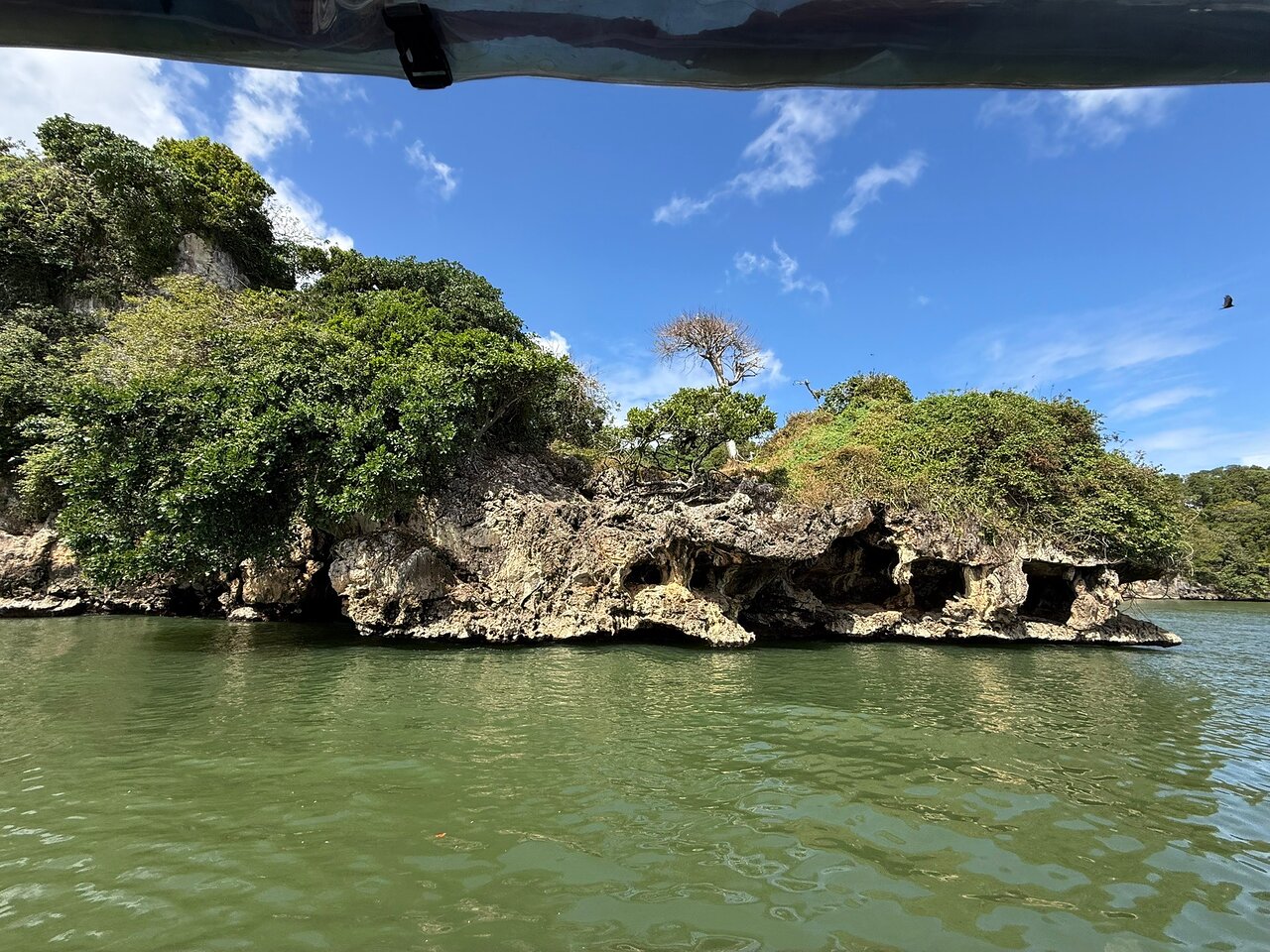
The distinctive limestone hills of Los Haitises are commonly known as mogotes. They rise above the surrounding lower areas and form one of the park's characteristic landscape features.
Soil conditions on these hills can differ from those in nearby depressions.
Shallow and uneven soil cover
Where limestone is close to the surface, soil may occur in small pockets, cracks and irregular patches rather than as a continuous deep layer.
Plant roots may grow through available soil and into fractures in the underlying rock. This means that the relationship between roots, soil and limestone is important for vegetation establishment.
Different conditions across a hill
A mogote is not necessarily uniform from top to bottom.
The crest, upper slope, lower slope and footslope can experience different combinations of sunlight, moisture movement, erosion and material accumulation.
Soil on exposed positions may be more vulnerable to drying or physical disturbance. Lower positions may receive material transported from higher parts of the slope.
The result is a small-scale mosaic of growing conditions that can influence which plants become established.
Vegetation adapted to local conditions
Plants growing on limestone terrain must respond to the conditions available in their particular location. Root systems, growth forms and water-use strategies can affect their ability to establish in shallow or irregular soil.
This variation contributes to the ecological diversity of the park's karst forests.
4. Soil in the Valleys and Lower Depressions
Between the limestone hills are lower areas and narrow valleys. These landscape positions can collect soil material and organic debris transported from surrounding slopes.
Historical botanical descriptions of the Los Haitises region distinguish between limestone mogotes and intervening valleys, noting differences in soil depth and vegetation.
Material accumulation
Rainfall, gravity and surface movement can transport small particles and organic material downslope. Some of this material may accumulate in lower positions.
The amount and type of material depend on local topography and drainage. Not every valley has identical conditions, and the presence of deeper soil should not be assumed everywhere.
Moisture and drainage
Lower depressions can experience different water conditions from elevated limestone surfaces.
Some may retain moisture for longer periods, while others may drain through the karst system. Water can move across the surface, through soil and into fractures in the limestone.
This combination of surface and underground drainage is an important characteristic of karst environments.
Different plant-growing conditions
Differences in soil depth, moisture and accumulated organic material can influence vegetation. Plants that grow well in one landscape position may be less suited to another.
The result is a relationship between topography, soil and vegetation that helps create the park's varied forest habitats.
5. Organic Matter: The Natural Foundation of Forest Soil
One of the most important components of forest soil is organic matter.
Organic matter comes from plant and animal material that enters the ground and gradually changes through decomposition. In a tropical forest, common sources include:
- Fallen leaves
- Small branches and twigs
- Dead roots
- Fruits and seeds
- Bark fragments
- Dead insects and other small organisms
- Other decomposing biological material
As these materials break down, they become part of the soil's organic component.
The role of leaf litter
Leaves falling from trees create a layer of litter on the forest floor. This layer is more than a covering of dead vegetation.
It can help reduce direct exposure of the soil surface to rainfall, contribute to moisture retention and provide food for decomposers.
Over time, decomposed leaf material contributes organic compounds and nutrients to the soil.
Organic matter and soil structure
Organic matter can influence how soil particles bind together and how much water the soil can retain.
It can also support soil organisms by providing energy and nutrients.
These functions are important in forest ecosystems, where the continuous production and decomposition of plant material help maintain nutrient cycling.
Why organic matter differs between locations
The amount of organic matter is influenced by vegetation, litter production, decomposition rates, soil moisture, temperature and land-use history.
For example, a forested area with a continuing supply of leaf litter may develop different soil properties from an area where vegetation has been cleared or repeatedly disturbed.
Research in the Los Haitises region has documented differences in soil organic matter between forested, regenerating and agricultural sites.
6. Soil Moisture and the Tropical Forest Environment
Water availability is essential for plant growth and soil biological activity.
Los Haitises receives substantial rainfall, but moisture conditions are not necessarily identical throughout the park. Topography, vegetation cover, soil properties and underground drainage all influence how water moves and remains in the landscape.
How soil stores water
Soil can hold water in spaces between particles and within aggregates. Some of this water remains available to plant roots.
The amount retained depends on soil texture, structure, organic matter and other physical properties.
In limestone terrain, the underlying rock and its fractures can also influence drainage. Water may infiltrate through the ground and move into the karst system.
The influence of vegetation cover
Forest vegetation can help moderate conditions at the soil surface.
Leaves and branches intercept some rainfall before it reaches the ground. Leaf litter can reduce direct exposure of the soil surface, while roots and organic matter influence soil structure.
Removing vegetation can change these relationships. The exposed ground may experience different rainfall impacts, moisture conditions and surface movement.
Seasonal changes
Rainfall varies over time, and soil moisture responds to both wet and relatively dry periods.
A study by Templer and colleagues examined soil properties and nutrient processes during wet and dry seasons in the Los Haitises region. The research found that soil moisture was greater during the wet-season sampling period than during the dry-season sampling period.
This illustrates why soil ecology should be understood as a changing process rather than a fixed condition.
7. Nutrients and the Soil Food Web
Plants need nutrients to grow and maintain their biological functions. In forest ecosystems, many nutrients are continually recycled through the movement of organic material between vegetation, soil and decomposer organisms.
The soil food web includes microorganisms and small animals that interact with dead organic material and one another.
Decomposition
Bacteria and fungi help break down organic material. Other soil organisms, including small invertebrates, can fragment leaves and mix organic material into the soil.
Decomposition gradually transforms complex plant material into simpler substances.
Nutrient release
As organic material decomposes, nutrients can become available for plant uptake. This process is part of nutrient cycling.
Nitrogen is particularly important because plants require it for proteins, enzymes and other biological compounds. Carbon is another major component of organic matter and is central to soil biological activity.
Microorganisms and soil function
Soil microorganisms contribute to processes such as respiration, decomposition and transformations of carbon and nitrogen.
The 2005 study by Templer and colleagues measured microbial biomass, respiration and nitrogen-related processes in different land-use settings in the Los Haitises region.
The findings showed that land use was associated with differences in soil properties and microbial activity. This demonstrates that soil is a living, biologically active part of the forest ecosystem.
8. What Research Reveals About Los Haitises Soil
One of the most relevant studies is Land Use Change and Soil Nutrient Transformations in the Los Haitises Region of the Dominican Republic, published in 2005 in the journal Soil Biology and Biochemistry.
The researchers examined soil properties and nutrient processes in undisturbed forest, regenerating forest and active agricultural sites within and directly adjacent to Los Haitises National Park.
The study provides useful evidence about how land use can influence soil in this karst region.
Soil organic matter and moisture
The researchers found that soil moisture and soil organic matter were significantly greater in regenerating forest sites than in active agricultural sites.
They also reported higher leaf-litter carbon and soil cations in regenerating forest sites compared with agricultural sites.
These results highlight the relationship between vegetation cover, organic inputs and soil conditions.
Bulk density
Bulk density was greater in active agricultural sites than in regenerating forest sites.
Bulk density describes the mass of dry soil within a given volume. Higher values can be associated with more compacted soil, although interpretation depends on soil type and other conditions.
Soil compaction can affect the movement of air and water through the ground and may influence root growth.
Microbial activity
The study also measured microbial biomass and respiration.
Some measures of microbial activity were greater in regenerating forest sites than in active agricultural sites when expressed per unit of dry soil.
The findings show that soil biological processes can respond to differences in vegetation and land management.
Why the findings matter
The study suggests that land-use history is important when understanding soil conditions in the Los Haitises region.
It also demonstrates why forest conservation is not only about protecting trees. The soil beneath the vegetation is part of the ecosystem and can be affected by how land is used.
The research included sites within and directly adjacent to the park, so its findings should not be treated as a complete soil survey of every habitat or location inside the protected area.
9. Soil Differences Between Forest and Agricultural Land
Land-use changes can influence the physical, chemical and biological properties of soil.
When forest is cleared for cultivation, the amount and distribution of organic material entering the soil can change. The ground may also be exposed to different levels of sunlight, rainfall impact and physical disturbance.
Changes in organic inputs
A forest supplies leaves, roots, branches and other organic material to the ground.
Agricultural land may receive a different quantity and type of organic input, depending on the crop, management practices and whether plant residues are retained.
Changes in organic inputs can affect soil carbon storage and nutrient cycling.
Soil compaction
Repeated movement by people, animals or machinery can compress soil under some conditions.
Compaction may reduce the size or connectivity of spaces between soil particles. This can influence water infiltration, drainage, aeration and root development.
The higher bulk density measured in active agricultural sites in the 2005 Los Haitises study is consistent with the importance of considering physical soil conditions when evaluating land-use impacts.
Changes in soil biological activity
Land-use changes can also alter the amount and quality of organic matter available to soil organisms.
Different vegetation covers provide different resources for microorganisms and decomposers. This can influence the rates and patterns of soil biological processes.
These changes are one reason why maintaining forest cover is important for protecting soil functions.
10. Soil and Forest Vegetation
The relationship between soil and vegetation works in both directions.
Soil influences which plants can establish and grow. At the same time, plants affect soil through root growth, litter production, water use and the addition of organic material.
Roots and soil stability
Plant roots can help bind soil particles and contribute to the stability of the ground.
In sloping areas, vegetation cover can reduce the exposure of soil to direct rainfall and help limit the movement of loose material.
The effectiveness of this protection depends on the type and density of vegetation, slope conditions and rainfall.
Leaf litter and nutrient return
Trees and other plants continually transfer nutrients from the soil into their tissues. When leaves, branches and roots die, some of these nutrients return to the ground.
Decomposition makes part of this material available for reuse by plants.
This cycle helps maintain forest productivity.
Soil conditions and plant diversity
Differences in soil depth, moisture and nutrient availability can contribute to differences in plant communities.
The contrast between limestone hills and lower valleys is therefore relevant not only to geology but also to the distribution of vegetation.
Soil is one of several environmental factors that shape the park's plant diversity.
11. Soil Conservation Challenges in Los Haitises
Soil is a slow-forming natural resource in many landscapes. Although tropical conditions can support active biological processes, disturbed soil does not automatically return to its original condition.
Several activities and environmental processes can affect soil quality.
Removal of vegetation
Clearing vegetation reduces the protection provided by tree cover, roots and leaf litter.
Exposed soil may become more vulnerable to rainfall impact and surface movement.
Compaction and repeated disturbance
Repeated traffic or poorly managed land use can compact soil.
Compaction can affect infiltration, aeration and root growth. It may also change how water moves across the ground.
Erosion
Erosion occurs when soil particles are detached and transported by water or other forces.
On slopes, rainfall and surface runoff can move loose material downslope. The loss of soil can reduce the material available for plant establishment and alter local ground conditions.
Changes in drainage
Disturbing the ground or changing vegetation cover can influence local water movement.
In karst landscapes, surface drainage is connected with underground pathways, making it important to understand local conditions before carrying out activities that alter the ground.
Why prevention matters
Preventing unnecessary disturbance is generally more effective than trying to restore heavily degraded soil later.
Protecting natural vegetation, avoiding unauthorized clearing and keeping visitor activities within permitted areas all contribute to the protection of the park's terrestrial habitats.
12. How Visitors Can Help Protect the Soil
Visitors may think mainly about protecting wildlife, caves and mangroves, but responsible behavior also helps protect the soil.
Small actions can reduce unnecessary disturbance.
Stay within authorized visitor areas. Avoid walking through vegetation or onto fragile ground outside permitted routes.
Do not remove plants or natural materials. Leaves, seeds, branches and other natural materials contribute to ecosystem processes.
Avoid creating informal trails. Repeated foot traffic can damage vegetation and compact the ground.
Do not leave rubbish. Waste can affect wildlife and the natural environment.
Follow local guides and park regulations. Guides and park authorities can provide instructions about where visitors may go and which areas should remain undisturbed.
Respect restoration areas. If an area is closed or marked for protection, do not enter it.
Responsible visitation helps protect the connected systems of vegetation, soil, water and wildlife that make Los Haitises important.
13. Why Soil Research Is Important for the Future of the Park
Soil research can help conservation managers understand how different habitats function and how they respond to environmental change.
In Los Haitises, further research could improve knowledge of:
- Soil depth and distribution across different karst landforms
- Organic matter and carbon storage in forest soils
- Soil moisture patterns across wet and dry periods
- Differences between mogote crests, slopes and valleys
- Soil biological activity in different forest types
- The long-term effects of land-use change
- Soil recovery after disturbance
- Relationships between soil conditions and native plant communities
A detailed, up-to-date soil survey covering the entire national park would be valuable for identifying local differences and supporting habitat management.
The existing research provides a foundation, but individual study results should not be treated as a complete description of every soil type in Los Haitises.
Conclusion: Protecting the Ground Beneath the Forest
The soil of Los Haitises National Park is shaped by the region's limestone geology, irregular karst topography, vegetation and water movement.
Soil conditions can differ between exposed limestone hills, slopes and lower valleys. Organic matter from leaves and other plant material supports nutrient cycling, while soil moisture and microbial activity contribute to the functioning of tropical forest ecosystems.
Research in the Los Haitises region has shown that land use can influence soil organic matter, moisture, bulk density and biological processes. These findings reinforce the importance of protecting natural vegetation and limiting unnecessary disturbance.
The park's forests depend on more than the trees visible above the ground. They also depend on the soil beneath them.
Protecting that soil helps preserve the ecological processes that support the biodiversity and natural landscapes of Los Haitises National Park.
Frequently Asked Questions
1. What type of soil is found in Los Haitises National Park?
Los Haitises is a karst landscape associated with limestone, but soil conditions vary across the terrain. Soil may be shallow or discontinuous on some limestone hills, while lower valleys and depressions can contain accumulated material. A single soil type should not be assumed to occur throughout the park.
2. Why is the soil of Los Haitises connected to limestone?
The park's landscape developed on limestone and related geological formations. Weathering and dissolution of limestone, together with the movement and accumulation of other material, influence where soil develops and how it is distributed.
3. Is soil deep throughout Los Haitises?
No. Soil depth can vary with topography and local geology. Some mogote surfaces have relatively little soil, while intervening valleys and lower positions may contain deeper deposits. Exact depth requires location-specific measurements.
4. What is organic matter in forest soil?
Organic matter is material derived from living organisms, including decomposing leaves, roots, branches and other biological remains. It contributes to nutrient cycling, soil structure and moisture retention.
5. How does rainfall affect soil in Los Haitises?
Rainfall influences soil moisture, decomposition and the movement of water through the landscape. In karst terrain, water may also enter fractures and underground drainage pathways. Soil moisture can change between wet and dry periods.
6. Why is soil important for the park's trees?
Soil provides physical support, water and nutrients for trees. It also supports microorganisms and other organisms that help decompose organic material and recycle nutrients.
7. Can farming affect soil in the Los Haitises region?
Yes. Research in the region found differences between agricultural and regenerating forest soils, including differences in organic matter, moisture and bulk density. The exact effects depend on land-use history and management.
8. Does forest recovery improve soil conditions?
The 2005 study found that several soil properties in regenerating forest sites were greater than in active agricultural sites. This suggests that some soil characteristics can begin to recover after agricultural use ends, although recovery is not necessarily complete or identical at every location.
9. How can visitors help protect the soil?
Visitors can stay within authorized areas, avoid creating informal paths, refrain from removing natural materials, dispose of waste properly and follow park regulations.
10. Is there a complete soil map of Los Haitises National Park?
The research discussed in this article does not establish a current, comprehensive soil map for the entire park. Specific soil classifications, depths and distributions should be checked against an authoritative soil survey before being reported as park-wide facts.
Local explorer & expert guide in Whale Miches.